#visa
Spouse Visa in Japan
A Spouse Visa is a family visa that allows a foreign national married to a Japanese national to live in Japan without the work restrictions. Learn the basic requirements and the application process.

A Spouse Visa is a family visa that allows a foreign national married to a Japanese national to live in Japan without the work restrictions. Learn the basic requirements and the application process.

A Spouse Visa is for individuals married to a Japanese national who wish to live with them in Japan. This residency status is available for durations of 6 months, 1 year, 3 years, or 5 years.
If you are based overseas and want to obtain this visa, you will need to secure a Certificate of Eligibility from Japan’s Immigration Bureau.
If you are already a mid/long-term resident in Japan, you can apply for a change of residency status.
While the Spouse Visa is primarily for spouses, it is formally known as “Spouse of a Japanese National, etc.” and also extends to foreign nationals who were born as children of Japanese nationals, including those known as “former Japanese nationals” who lost their Japanese nationality upon acquiring another country’s nationality.
Holders of a Spouse Visa are allowed to work without restrictions, though certain jobs may require additional licenses or qualifications in Japan. The requirements for permanent residency are also relaxed for them.
The process and required documentation for obtaining a Spouse Visa in Japan can vary depending on whether you are legally married or not.
If you are married already, it is about getting the certificates and other documents to prove that you are indeed married, and that you can financially support yourself as a household.
If you are not yet married but are planning to be, start communicating with your spouse’s consulate or embassy and follow the legal marriage procedure in Japan. You will need marriage certificates from both countries for the visa application; it is also generally expected that, if you are married in Japan, the marriage is also considered valid in your home country. An exception applies if your country is one of those that do not issue a certificate of marriage, such as the UK.

The marriage process in Japan involves submitting a signed Marriage Registration Form called “Kon-in Todoke” to the local municipal office where you reside.
This submission should be accompanied by other necessary documents, such as a Certificate of No Impediment issued by your home country’s embassy or consulate.
Once the marriage is registered, you usually need to report it to your embassy or consulate with the marriage certificate issued by the municipal office.
Since required documents may vary by country, please confirm the details with your embassy or consulate first.
Marriage Registration Form (Kon-in Todoke) Sample
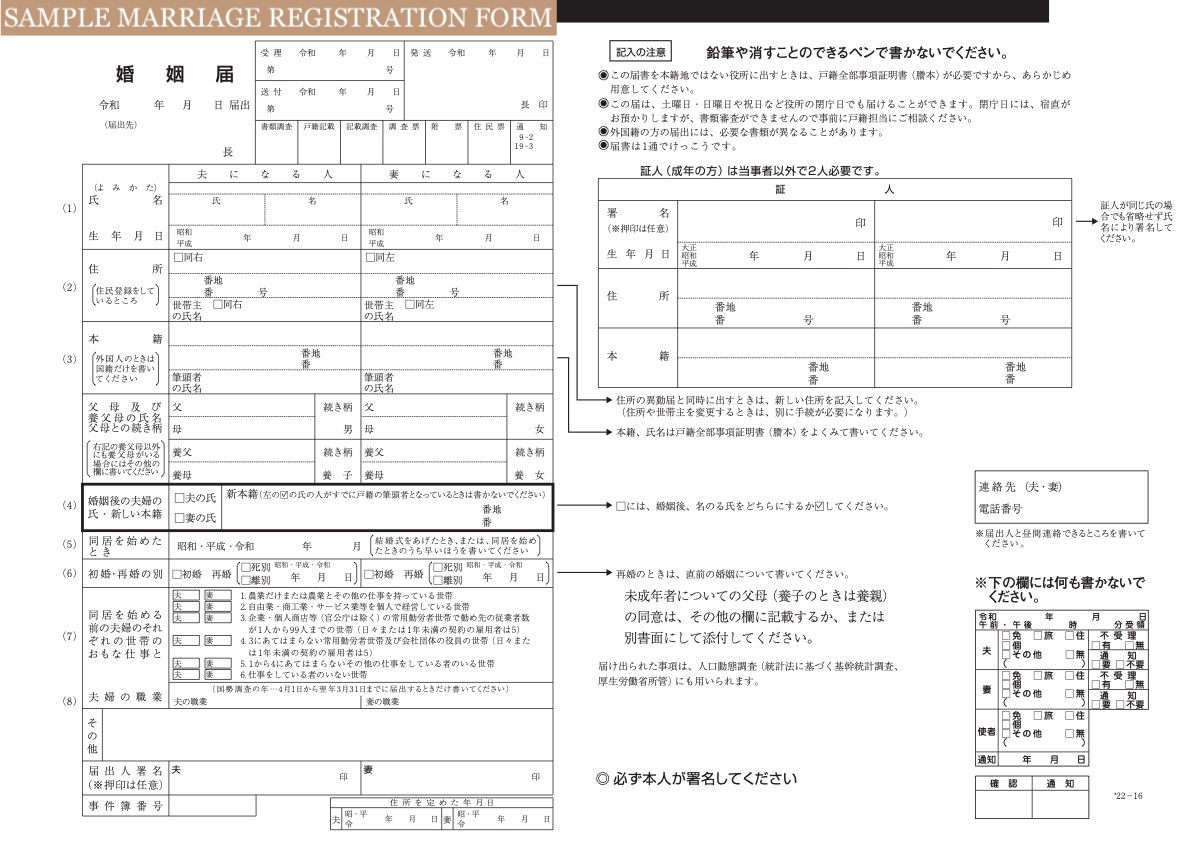
For your reference, here are the items you need to get legally married in Japan:
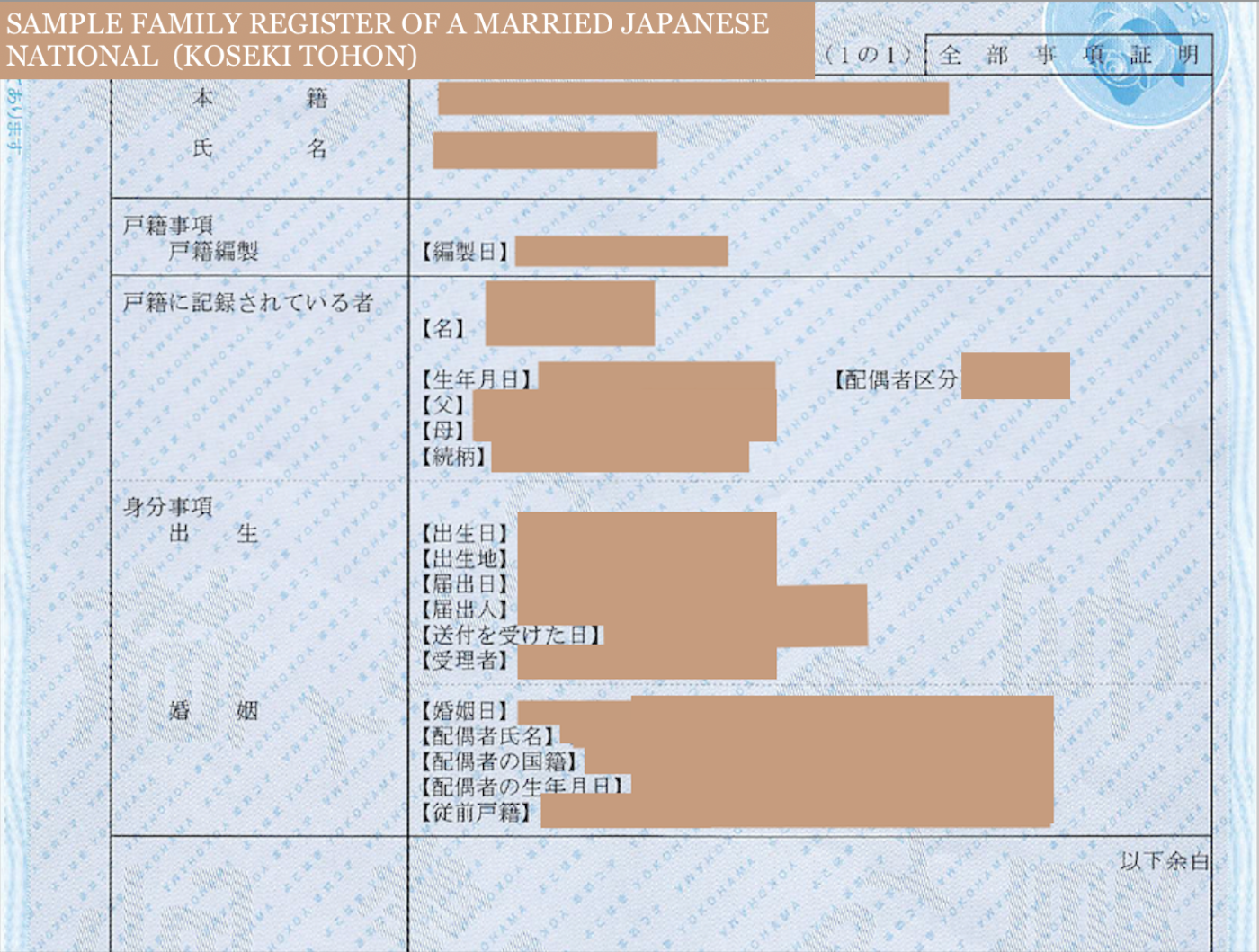
Once the Marriage Registration Form is accepted, your name will be recorded in your spouse’s family register also known as Koseki.
Only Japanese nationals can have a Koseki, so while you are not “in the Koseki” yourself, you will be listed as the spouse.
Japanese Spouse’s Family Register (Koseki Tohon) Sample:
Unfortunately, Japan does not currently recognize same-sex marriage. As a result, if your spouse is of the same sex as you, you cannot legally get married in Japan.
In this article, we are mainly discussing the Spouse of a Japanese National visa, but there are other types of spouse visas available in Japan, such as the following:
Once you have all the required documents ready—which we will discuss shortly—here are key steps for obtaining a Spouse Visa.
Step 1: Your Japanese spouse, along with all the required documents, applies for a Certificate of Eligibility (COE) at the Immigration Bureau in Japan.
Step 2: Once the application is approved, the Japanese spouse can send the COE to you. If the application was submitted online, you will receive a digital COE.
Step 3: You must bring the COE to the Japanese Embassy or Consulate in your home country to have the visa issued on your passport.
Step 4: You must enter Japan within three months of the COE’s issuance, and you will receive your residence card at the airport.
Step 1: Get married in Japan. If you are already married, gather the necessary certificates and documents to prove your marriage.
Step 2: Submit all the required documents to the Immigration Bureau to apply for a change of visa status from your current visa to a Spouse Visa.
Step 3: The Immigration Bureau will notify the foreign spouse of the result after a 2–4 month review process.

The list of required documents varies depending on your circumstances, but here is a general guide.
Reference: Ministry of Justice
At Small Seasons & Co., we provide a personalized list to increase the chances of visa approval.
If you want to delegate the complicated bureaucratic work that takes up your precious time (we know how stressful the workload can be!) or have concerns regarding some elements of the application, like the financial stability of the household, feel free to reach out to us!
3The initial period of stay granted for a Spouse Visa is usually 1 year, and you may receive a 1-year extension for the following year as well.
Upon the second/third renewal, you may be granted a 3- or 5-year period, depending on the immigration office’s assessment of the stability of your relationship and household.
At Small Seasons, we have successfully secured a 3-year visa from the very initial application for our clients. This also depends on the kind of documentation the client can provide, and it is not just about technique but the content of the application.
If you would like to discuss whether this is something you could aim for, we are happy to talk it through with you.
There are certain factors that could make the Immigration Bureau scrutinize your application, such as:
While these are not always obstacles to a successful application, if any of them apply to you, it is best to provide a sufficient explanation in advance so that immigration won’t need to ask additional questions.
You shouldn’t lie on your application either to make it look “better”. If you are caught lying on the application (and keep in mind that they can always request additional information and find out about inconsistency), your application will most likely be rejected.
If either spouse has been divorced multiple times, especially in a short period, immigration may suspect a marriage of convenience or visa fraud. They may request additional proof of the genuine nature of the relationship.
Age gaps are not a legal barrier, but a significant difference may raise concerns about the authenticity of the marriage. You may need to provide additional evidence of your relationship, such as photos, messages, or travel history together.
While meeting through an app is becoming more common these days, applications from couples who met this way may face extra scrutiny. We recommend submitting detailed proof of how the relationship developed, including communication history, visits, and time spent together.
If you got married shortly after meeting or dating for less than a year, immigration may question the stability of the relationship, or wonder whether there was another reason for the rush, such as an expiring visa. This doesn’t mean a short relationship automatically leads to rejection, but you should be prepared to explain the circumstances clearly and provide evidence that the relationship, despite its short timeline, is genuine and stable, such as consistent communication records, visits, or a clear account of how the decision to marry came about.
The Japanese Immigration Bureau values family bonds and believes that marriage is a union between two families, so a certain level of family involvement is expected.
If a couple has never met each other’s family or has minimal contact with them, it could raise doubts about the legitimacy of the relationship. Be ready to submit additional supporting documents, such as reasons why you haven’t been able to meet often if you cannot submit family pictures, or any other relevant justification.
The processing time usually takes 4 to 6 months, although it can sometimes take longer depending on factors such as how straightforward the case is and how busy immigration is at the time.
The preparation process for a Spouse Visa tends to be quite extensive, as it requires a thorough understanding of the couple’s relationship and history.
At Small Seasons, we conduct an hour-long interview that covers everything from how you met and what led to marriage, to your future plans, lifestyle, and how you will maintain your relationship.
We believe the more personalized the application, the stronger it will be.
You can start the renewal of your spouse visa as early as three months before the expiration date of your current visa. The renewal process is much simpler than the first application, as you will not need to submit the filled-out questionnaire this time.
Case Study | Overcoming Financial Hurdles for a Spouse Visa Renewal
Case study of a Japanese and Russian couple who received a one-year visa extension despite having financial difficulties.
A key requirement is that you have been married for more than three years, have lived continuously in Japan for more than a year, and have at least a three-year period of stay (the government is currently discussing changing this to a five-year period) on your residence card.
The Permanent Resident Visa application also requires that you have fulfilled other legal obligations, including but not limited to paying all taxes on time without any delays. These records will be checked for the past three years, so be sure to double-check if you have changed jobs in the past and experienced any payment delays, as this could result in your PR application being rejected.
Your first COE application ever becomes the reference point for everything that follows. If this is your first application, immigration will use it as the baseline to compare against in future renewals.
If it is not your first application, immigration will cross-check the foreign spouse’s work and education history against what was declared previously, so any inconsistency with your very first submission can raise questions years later.
So it is worth taking the time to get the details right from the start, and to keep this in mind for any paperwork going forward.
From your job title to smaller details like flight dates or your graduation month, we recommend keeping a document that tracks the information you have provided to immigration, and checking it regularly against the source to make sure it stays accurate and up to date.
We understand the temptation to include extensive documentation, such as numerous pictures and chat screenshots, to prove the history of your relationship for the initial Spouse Visa application. It’s crucial, however, not to overdo it, as immigration officers may not have the time to thoroughly review every detail.
It’s important to be selective about the evidence you provide. When including pictures, ensure they are meaningful and not just generic couple photos. Ask yourself if they demonstrate significant milestones in your relationship, such as meeting each other’s families.
Remember to keep it simple and focus on quality over quantity.
Our team is fully bilingual and proficient, ensuring a seamless and efficient handling of your case. If you want to delegate the work, we are here to support you.
The Spouse visa is unique in that, as immigration lawyers, we need to ask you personal questions to represent you effectively. The more personal information you provide, the more convincing your application will be.
We strive to be the kind of lawyers you can trust to share these personal details with, along with any concerns or unique aspects of your situation that might affect the approval rate.
We understand the importance of staying together as a family and will do our best to come up with a solid solution for you.
Initial Consultation:
Engage in an initial paid consultation to discuss your needs.
Estimation Confirmation:
Review and confirm the estimate issued by Small Seasons & Co.
Contract Signing and Advance Payment:
Sign the contract and make the required advance payment.
Strategy Session:
Participate in in-depth discussions regarding timelines and required materials.
Document Collection and Signing:
Obtain necessary items and complete the required document signings.
Certificate of Eligibility (COE) Application Submission:
Small Seasons & Co. will manage the submission of your COE application.
Feedback on COE Results:
Receive feedback on the COE application results; if approved, the original copy will be delivered to your address.
Japanese Visa Issuance:
Take the COE to a Japanese embassy/consulate in your home country to obtain your visa.
Entry into Japan:
Enter Japan within 90 days of the COE issuance.
There is no fixed number set in law. Immigration instead makes a broader judgment: combined income, savings,etc. That said, it is naturally more favorable if you have consistent income coming in, and it also depends on your expenses. Do you live in a city or a suburban area? Do you own your home or will you rent? At Small Seasons, we evaluate this based on the documents available and, depending on the case, may ask you to submit additional documents to strengthen your application.
Generally speaking, no. Tokyo Immigration no longer allows switching directly from a Tourist Visa to a Spouse Visa. There was never a formal direct change-of-status application available for this; rather, it was a special treatment offered to those whose COE was issued while they were on a Tourist Visa. We do not recommend relying on this approach anymore, unless there are humanitarian reasons you can argue for, but “because you are married” unfortunately isn’t enough on its own.
Processing could take 4 to 6 months for a Certificate of Eligibility, though it can extend beyond 6 months depending on the case. Regional immigration bureaus outside Tokyo, such as Osaka or Fukuoka, tend to process faster due to lower application volume.
Yes, one of the advantages of the Spouse Visa is that it doesn’t come with work restrictions like many other visa types. That said, some professions (medicine, law, etc.) still require their own separate licenses or qualifications in Japan, regardless of your visa status.
No. Japan does not currently recognize same-sex marriage, so unfortuantely a Spouse Visa on this basis isn’t available for same-sex couples. A “Designated Activities” (特定活動) visa, however, is available to foreign same-sex couples, provided both parties have a marriage that is legally valid in their respective home countries.
You can begin as early as 3 months before your current visa expires. You could of course start preparing even earlier, but also note that whatever official documents you submit, such as tax certificates, should be issued within 3 months of your submission date.
No. Renewal is simpler than the initial application, and the lengthy questionnaire isn’t required the second time around.
You generally need to have been married for more than 3 years, lived in Japan continuously for over a year, and hold a Spouse Visa with a certified term of stay of 3 years or more. Consistent, on-time tax payments over the past 3 years also matter. Note that the government is currently discussing changing this period to 5 years, as well as introducing income and expected pension amount requirements, so there may be additional requirements to fulfill in the future.
This varies depending on how quickly required documents (such as marriage certificates, tax records, and the relationship questionnaire) can be gathered, but we typically need 1-1.5 months from the initial consultation to submission.
Once submitted, the immigration bureau’s own processing time (4-6 months) is separate and outside our control.
Yes. We regularly support clients applying from outside Japan, guiding the Japanese spouse through the COE application process and coordinating with you remotely throughout. That said, you will need a family member residing in Japan, if not your Japanese spouse themselves, to apply for the COE while you are overseas.
Yes. Our team is fully bilingual, so you can work with us entirely in English or Japanese, whichever is more comfortable for you, from the initial consultation through document preparation and submission.
Related Articles:
Case Study | Overcoming Financial Hurdles for a Spouse Visa Renewal
This is a case study of a Japanese and Russian couple who received a one-year visa extension despite having financial difficulties.